
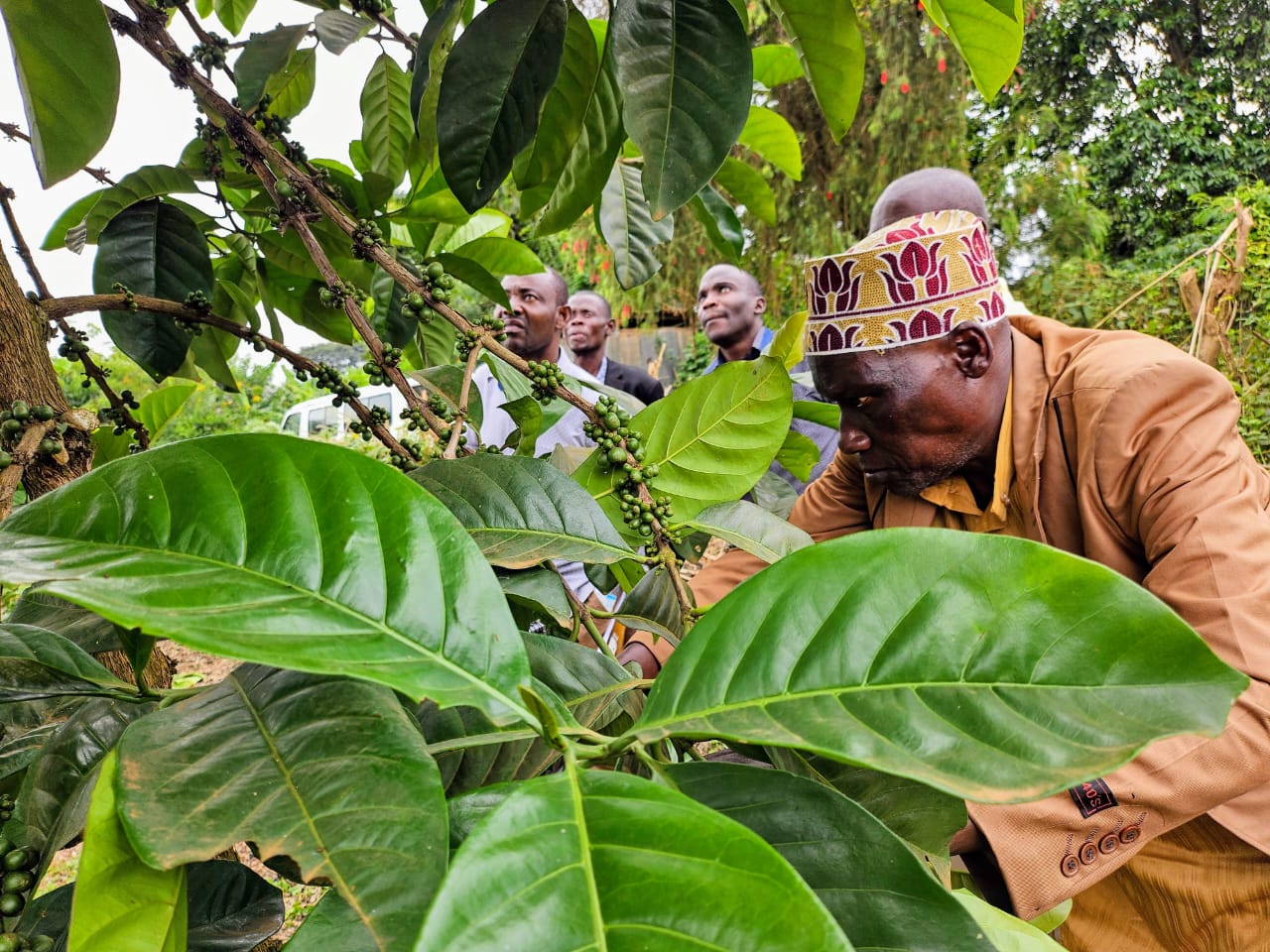
The National Agricultural Research Organisation–National Agricultural Research Laboratories (NaRL) at Kawanda has hosted coffee farmers from Zirobwe and Butambala for a participatory assessment of the performance of Excelsa coffee varieties, as efforts intensify to promote the crop as a new income earner for Ugandan farmers.
The meeting, held on Thursday, brought together farmers, scientists, and private sector players to evaluate ongoing trials being conducted by the National Agricultural Research Organisation in partnership with Makerere University and Kyagalanyi Coffee.
The research aims at identifying superior Excelsa coffee varieties ahead of their official release to farmers.
Excelsa coffee naturally grows in the wild within Zoka Central Forest Reserve and Semuliki National Park. However, scientists say many farmers, especially in Central Uganda, have been cultivating the crop using traditional knowledge without sufficient scientific guidance.
According to the spokesperson of the National Agricultural Research Organisation, Frank Mugabi, the institution is undertaking the research to establish the full agricultural and commercial potential of the crop.
“NARO is only playing its role of agricultural research to establish the potential of this coffee since it is already being grown in some areas and also naturally available in the two forests,” Mugabi said.
He added that several critical areas still require scientific study, including yield forecasting, disease management, spacing, and adaptation to different agro-ecological zones.
Scientists involved in the project revealed that Excelsa varieties from Zoka Forest Reserve have shown stronger resistance to harsh weather conditions compared to those from Semuliki, prompting further trials to identify region-specific suitability.
Researchers say Excelsa coffee has several advantages over Arabica and Robusta, including higher yields, larger berries, and greater resilience to climate stress and disease pressure.
They also note that the crop could provide farmers with an additional income stream beyond existing coffee production systems.
Early market results have shown promising returns. In 2023, Kyagalanyi Coffee purchased 5,508 kilogrammes of Excelsa coffee from 13 farmers in Luwero District at an average of Shs4,810 per kilogramme of dried cherry, a 66 percent increase compared to the Robusta baseline price of Shs2,900 per kilogramme.
The project is currently developing two main Excelsa coffee products — Kiboko (naturals/pods) and Honey Coffee (parchment).
During the 2024–2025 season, Kyagalanyi Coffee bought 85 metric tonnes of kiboko at Shs7,000 per kilogramme and 3.5 metric tonnes of parchment at Shs18,000 per kilogramme, reflecting growing market uptake.
Researchers estimate that Excelsa coffee could raise farm incomes by 46 percent even at parity pricing with Robusta, and by up to 142 percent under premium pricing models.
Scientists and stakeholders now believe the crop could play a key role in diversifying Uganda’s coffee sector while strengthening farmer resilience to climate change.
